Open usage#
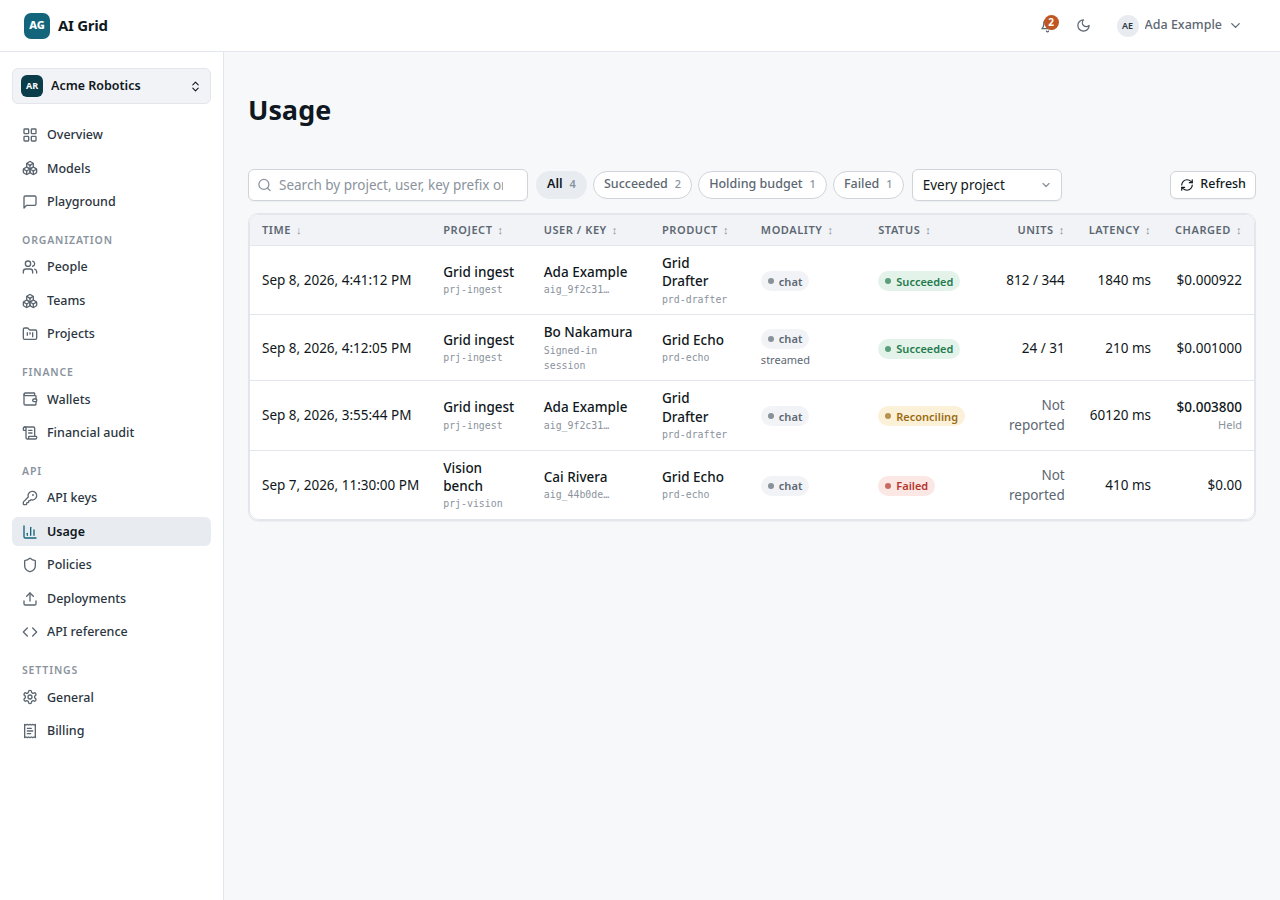
Open Usage under the API group in the left rail. Each row is one call:
| Column | Meaning |
|---|---|
| Status | Succeeded, Holding budget or Failed |
| Project / User | Who paid and who called (key prefix, not the secret) |
| Product / Modality | What answered, and whether it streamed |
| Tokens / Latency | Metered usage and round-trip time |
| Reserved / Charged | Micro-USD held before dispatch vs finally charged |
What you see depends on your role: Owner and Administrator read Every call in this organization; everyone else reads their own calls only. The same columns appear on a project's Usage tab, scoped to that project.
Use the status chips (All / Succeeded / Holding budget / Failed), the project selector and Search to narrow the list. Click Refresh to reload.
Read a call's record#
Click a row to open the request detail. The stats strip answers the money question:
- Reserved before dispatch — the ceiling AI Grid held from the project wallet before calling the provider.
- Charged — what verified usage actually cost after settlement.
- Released — the difference handed back. While a reservation is still open the strip reads Still held instead.
Below that, three cards:
- Request — the model, parameters and outcome.
- Provider attempt — the upstream status (HTTP status, or
mock,transport_error,unconfigured) and any recorded error code. - Recorded events — the reservation, settlement and reconciliation events recorded for this invocation, in order.
What the statuses mean#
- Succeeded — usage was verified and the reservation settled to the actual charge; the remainder was released.
- Failed — a definite pre-dispatch or 4xx error. The reservation was released in full; nothing was charged.
- Holding budget — the outcome is unknown: a timeout, incomplete response, 5xx or unverified usage. The reservation stays open for reconciliation rather than being guessed at. Abandoned holds become eligible for operator reconciliation after five minutes.
Why a call is refused#
Refused calls create no usage row, no reservation and no charge — the refusal is enforced before any money moves. Permission refusals are still recorded as audit events. The common codes and where to fix them are in Troubleshooting.